|
|
Lens antenna
convert spherically radiated microwave energy into a plane wave (in a
given direction) by using a point source (open end of the waveguide) with a
collimating lens. A collimating lens forces all radial segments of the spherical
wavefront into parallel paths. The point source can be regarded as a gun which
shoots the microwave energy toward the lens. The point source is often a horn
radiator or a simple dipole antenna.
WAVEGUIDE TYPE LENS
The waveguide-type lens, sometimes
referred to as a conducting-type, consists of several parallel concave metallic
strips which are placed parallel to the electric field of the radiated energy
fed to the lens, as shown in figure 1, views (A) and (B). These strips act as
waveguides in parallel for the incident (radiated) wave. The strips are placed
slightly more than a half wavelength apart.

Figure 1.
Waveguide lens.
The radiated energy consists of an infinite number of RADIAL SECTIONS (RAYS).
Each of the radial sections contains mutually perpendicular E and H lines and
both are perpendicular to the direction of travel. Because each of the radial
sections travels in a different direction, the point source, in itself, has poor
directivity. The purpose of the lens is to convert the input spherical microwave
segment (which consists of all of the radial sections) into parallel
(collimated) lines in a given direction at the exit side of the lens. The
focusing action of the lens is accomplished by the refracting qualities of the
metallic strips. The collimating effect of the lens is possible because the
velocity of electromagnetic energy propagation through metals is greater than
its velocity through air. Because of the concave construction of the lens,
wave-fronts arriving near the ends of the lens travel farther in the same amount
of time than do those at the centre. Thus, the wave-front emerging from the exit
side of the lens appears as a plane wave. It consists of an infinite number of
parallel sections (with both the E field and H field components) mutually
perpendicular to the direction of travel.
DELAY LENS
Another type of lens that you may see is the dielectric or metallic delay lens
shown in figure 3-11. The delay lens, as its name implies, slows down the phase
propagation (velocity) as the wave passes through the lens. The delay lens is
convex and is constructed of dielectric material. The delay in the phase of the
wave passing through the lens is determined by the dielectric constant
(refractive index) of the material.
In most cases, artificial dielectrics, consisting of conducting rods or spheres
that are small compared to the wavelength are used. (Artificial dielectrics are
of three-dimensional construction and act as a dielectric to electromagnetic
waves.) In this case the inner portion of the transmitted wave is decelerated
for a longer interval of time than the outer portions. The delay causes the
radiated wave to be collimated.
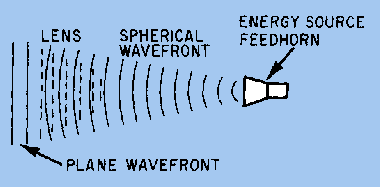
Figure 2.
Delay-type
lens.
LOADED MICROWAVE LENS
The loaded microwave lens, shown in figure 3, is a multi-cellular array of
thousands of cells. Each cell contains a slow-wave (delayed), serrated-metal,
plastic-supported waveguide element which acts as a phase-controlling device. A
loaded lens can focus microwave energy in much the same way as the waveguide
type. The reason is that the speed of propagation is higher in the region
between parallel plates than in free space. The parallel plates support the
cells.
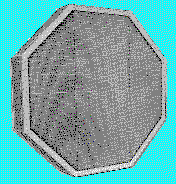
The lens shown in Figure 3 has an egg-crate appearance because it is really two lenses occupying the same volume. Vertical plates make up a lens that focuses a vertically polarized beam, and horizontal plates handle beams which are horizontally polarized. In other words, this type of construction can be used in multiple-beam applications where the polarization of the beams is different.
REVIEW QUESTIONS & ANSWERS
Q.12.
What is the purpose of a collimating lens?
A12.
Forces the radial segments of a wavefront into parallel paths.
Q.13. How does a waveguide-type lens
focus spherical wavefront microwave energy?
A13.
Some wavefronts are accelerated so that all wavefronts exit the lens at the same
time.
Q.14.
What type of lens decelerates a portion of a spherical wavefront?
A14.
Delay lens
.PNG)